Seven Common Mistakes Visitors Make at Small Neighborhood Festivals
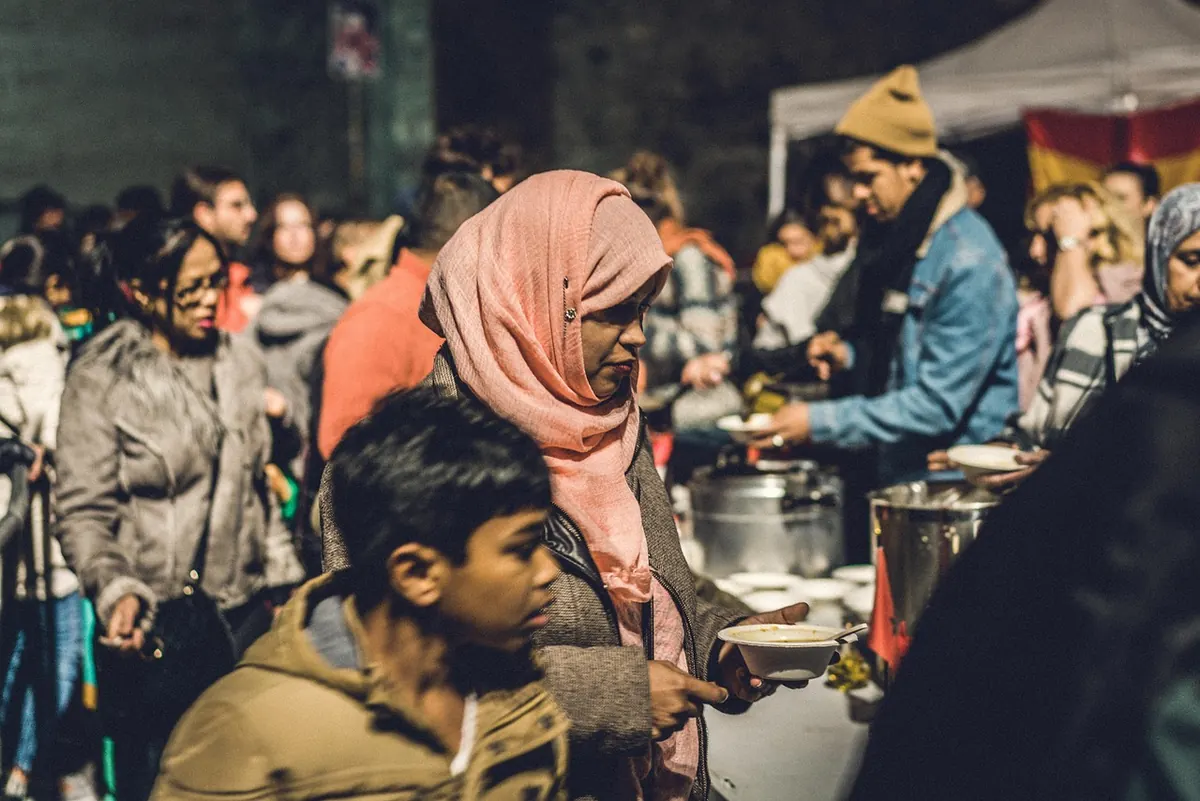
Every small festival keeps its own clock. In a city you join a queue, order, eat, pay and go home. In a village square or a parish hall, the same evening runs on a handwritten menu, one cash box, a raffle drawn from a hat, and a volunteer with a ladle who also happens to know where the spare chairs are kept. Visitors rarely ruin a night out. But the same few mistakes come up again and again, and every one of them is easy to avoid once you know what to look for.
1. Reading the queue as if it were a city queue
At a small festival the line often doesn't start where you expect. It starts where the stack of trays is, or where the sign-up sheet sits, or at the folding table where one woman is taking orders and money at the same time. Walk up, watch for thirty seconds, then ask. A simple "is this the queue?" saves you from standing proudly in a line that turns out to be for the raffle.
Two things help. First, work out whether there is one line or two — many festivals separate the cash desk, where you buy tickets or pay, from the food counter, and the split is frequently unmarked. Second, don't hold a place for six people who are still deciding what to eat. Send one person to queue by all means, but have the others ready to carry plates the moment they arrive.
And when you reach the counter, order. Stepping back to debate the menu with your group while the volunteer waits, ladle in hand, is the single most effective way to slow an entire festival down.
2. Taking a seat, and then taking up half the room
The table
Long trestle tables and benches are shared by design, but not every chair is free. Some are saved for the musicians, some for the people who arrived at dawn to set up, some for an older couple who have sat in the same corner for twenty years. If there's a jacket or a folded piece of paper on a seat, it's taken. Ask before you move a chair to another table; it will be moved back later by someone who has been counting them.
At the busiest hour, take only the seats you need. Spreading four bags across a table for eight is the fastest way to make quiet enemies in a small room. And slide along the bench rather than climbing over it — the person beside you is holding a plate of something hot.
The service lane
Every festival has one. It's the gap between the grill and the first row of tables, or the path from the kitchen tent to the counter. It looks like empty space and it is not. Standing there to finish a conversation, or planting a tripod in it, blocks the only route the food has. The same goes for doorways, the area around the water tap, and the narrow passage where the washing-up happens.
3. Photographing whatever catches your eye
The square at dusk, the trays of food, a cook's hands over the grill: these are usually welcome, and people are quietly pleased when a visitor bothers to photograph their work. Faces are different. A raised phone and a questioning look does the job; if someone shakes their head, put the phone down and move on without a performance of disappointment. Children need a nod from the parent, not only from the child.
Skip the flash in a dim hall. Don't stand in the service lane to frame a shot. And when a glass is raised, when the raffle numbers are called, or when something is carried out of the kitchen with a bit of ceremony, put the phone away for a minute. Those are the moments people came for, and you'll see more of them without a screen in front of your face. If a sign says no photographs, or the setting is a church or a procession, follow the room.
4. Assuming the menu, the money and the timing work like a restaurant
- The menu is short and changes. It reflects what was available that week and what the kitchen can actually produce at volume. If a dish has run out by nine, that's usually a good sign, not a failure.
- Ask what's in a dish. Volunteers are proud of what they cook and happy to explain it; a question is a compliment, not an inconvenience.
- Be direct about allergies. Say exactly what the problem is and ask to speak to whoever is cooking. If your allergy is serious, don't rely on a busy volunteer's memory in a crowded kitchen tent — make your own judgment from what you hear. For anything uncertain, speak to a medical professional rather than the person with the ladle.
- Carry cash, including small notes. Cards may well work, but signal in a stone square is unreliable and the card reader belongs to somebody's cousin.
- Buy your tickets where the tickets are sold. If there's a separate till for drinks or the raffle, the food counter probably can't help you.
Timing matters too. Service has a peak: the first half hour is calm and the grill queue at eight-thirty is not. If you want to eat quickly, arrive early. If you want company, arrive later and eat when the first rush has passed. Either way, don't turn up an hour before opening and ask whether the kitchen is ready — the answer is usually "not quite", and the person telling you is still unfolding chairs.
5. Missing the small customs: the toast, the raffle, the plates
Every festival has three or four moments that aren't written anywhere. Someone stands up and taps a glass. Conversation stops, glasses are raised, and in Italy you look the person in the eye as you clink — a small thing that reads as good manners and costs nothing. There's a raffle or a tombola: buy a strip of tickets early and stay for the draw. Slipping out at the exact moment your number might be called is noticed, even if nobody says so.
The other custom is the sink. Nobody clears your table at a festival run by volunteers; there's a basin behind the tent with a short queue of people scraping plates. Stack yours, carry them over, drop your glass in the crate. It takes ninety seconds and it is the whole difference between being a guest and being a customer.
6. Arriving late, leaving early, and never offering to help
A festival day has two halves. The first is the meal. The second is everything after it: the raffle, the music, the conversation that only begins once the plates are cleared. Visitors who eat and leave at half past nine see the least interesting part of the evening. Staying one more hour is usually worth more than the extra photographs.
At the other end of the day, don't expect a finished event at six o'clock. If you see someone wrestling a folding table through a doorway or dragging a crate of water across the square, ask whether they need a hand. Help is genuinely welcome, but ask first — a stranger picking up the wrong knife is not help. And if chairs start going up around you, you have two good options: leave gracefully, or stay and stack them.
A short checklist for the next one
- Ask which line is which before you commit to it.
- Order when you reach the counter, not while you're standing at it.
- Take only the seats you need, and keep the service lane clear.
- Ask before photographing faces, and put the
Photo: Antonio_Cansino / Pixabay